

How to Build a Website for a Courier Business
A practical guide to creating a courier website that builds trust, ranks locally and generates genuine customer enquiries.
Courier Website Essentials
A good courier website doesn’t need to be complicated or expensive. Its main job is to tell potential customers what you deliver, where you operate, why they can trust you and how they can quickly get in touch or request a quote.
Having spent decades working in delivery and running courier businesses myself, I’ve seen the difference a clear online presence can make. Customers often need transport at short notice, so your website needs to answer their most important questions quickly, particularly on a mobile phone.
At a minimum, your website should clearly show your services, coverage area, contact details and insurance, along with genuine reviews or other trust signals. A simple quote or enquiry form can make it much easier for customers to provide the information you need without a long exchange of emails or messages.
Your website should also work alongside your Google Business Profile and other relevant business listings. This helps establish your location and services, while giving potential customers several ways to discover and verify your business.
You don’t need dozens of pages when you’re starting out. A fast, well-structured website with useful information and clear contact options will usually provide a much stronger foundation than a large site filled with generic content.
Help Local Customers Find Your Courier Business
Most independent courier businesses don’t need to rank nationally. What matters is being visible when someone in your service area searches for the type of transport you provide.
Start by creating and fully completing a Google Business Profile. Make sure your business name, phone number, website and service areas are accurate, add genuine photographs and encourage satisfied customers to leave reviews.
Your website should reinforce this information. Create clear pages explaining the services you actually provide and the locations you genuinely cover. For example, a motorcycle courier serving Cornwall and Devon will benefit more from detailed, useful information about motorcycle transport in those areas than dozens of thin pages targeting towns they’ve never worked in.
Search is also changing. Google and other platforms increasingly use website content, business profiles, reviews and other trusted sources to generate AI-powered answers. There’s no magic formula for appearing in these results. The best foundation is still accurate business information, useful original content and evidence that your company genuinely provides the services it claims to offer.
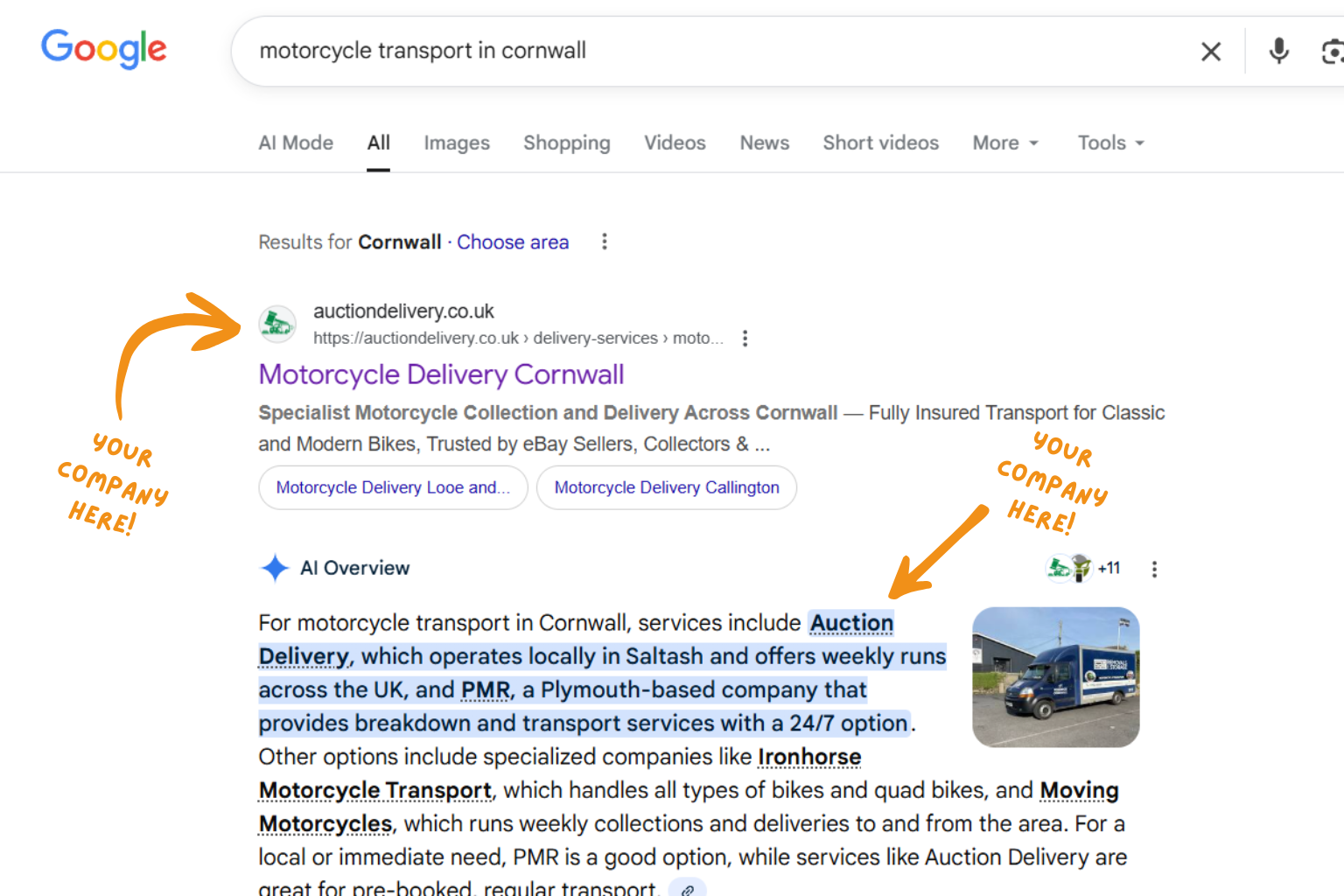
The example below comes from one of my own delivery businesses, showing how a specialist local service can appear in both conventional Google results and an AI-generated overview.
Build Your Website Around What Customers Need
Courier customers are usually looking for answers to a few simple questions: Can you transport what I need? Do you cover my area? When can you do it? How much will it cost? And can I trust you?
Your website should make those answers easy to find. Clearly explain the types of deliveries you handle, the vehicles you operate and the areas you cover. If you specialise in something such as motorcycles, fragile goods, furniture, e-bikes or same-day delivery, make that obvious rather than trying to appear as though you handle everything.
Trust is particularly important. Display genuine customer reviews, explain what insurance you carry and use photographs of your own vehicles and completed jobs wherever possible. A potential customer is far more likely to trust a real courier business than a website filled with generic stock photographs and vague claims.
Make contacting you simple too. Your phone number, email address and quote form should be easy to find, particularly on mobile. Ask for the information you actually need to price a job, such as collection and delivery postcodes, item details, preferred dates and any access restrictions.
Finally, write for customers rather than search engines. Useful service and location information naturally gives Google context about what you do and where you operate, while still providing something genuinely helpful to the person reading it.

Essential Pages for a Courier Website
A courier website doesn’t need dozens of pages, but there are a few essentials I’d recommend for almost every delivery business.
Home: Clearly explain what you do, where you operate and why customers should choose you. Make it immediately obvious how to request a quote or contact you.
Services: Give your main services their own useful sections or pages. A motorcycle courier, for example, might cover motorcycle transport, eBay collections, classic bike transport and dealership deliveries separately.
Areas Covered: Explain your genuine operating area. If you regularly serve particular counties, cities or regions, provide useful information rather than creating dozens of near-identical location pages.
About: Tell customers who they’re dealing with. Your experience, vehicles and background can be a major advantage for a small independent courier.
Contact / Quote: Make getting a price as straightforward as possible. A good quote form can save considerable time by collecting the information you need before you respond.
Courier Website Essentials Checklist
DIY or Professional Website Design?
Building your own courier website is perfectly realistic, particularly if you’re starting small. WordPress and modern website builders make it possible to create a professional-looking site without being a developer, and keeping things simple can produce excellent results.
The main investment is your time. You’ll need to learn the basics of website design, hosting, security, mobile optimisation and SEO, as well as writing the content and keeping everything updated.
Paying a professional can make sense if you’d rather concentrate on running your courier business, or if you need more advanced features such as online booking, automated quote forms or integrations with other systems. Whichever route you choose, concentrate on creating a fast, trustworthy website that makes it easy for customers to understand what you do and contact you.
Building a Courier Website That Actually Works
A successful courier website doesn’t need to be complicated. It needs to answer the questions potential customers have, demonstrate that you’re a genuine and trustworthy operator, and make it easy for them to get in touch.
Start with the basics, keep your service and coverage information accurate, use your own photos wherever possible and build your reputation through genuine customer reviews. As your business grows, you can add more detailed service pages, useful content and additional features when they’re actually needed.
And remember that your own website doesn’t have to work in isolation. Building visibility across Google, business directories, and other relevant platforms can help customers discover your company in more places.